

 Back
BackCSR The environment
Using human urine as a biostimulant for agriculture
16 June 2022
Happee Services and start-up Toopi Organics have been partners since 2020. A collaboration based on reclaiming something that has always been considered a waste product: human urine.
Promoting the circular economy
The founding principle of the partnership between the two companies is simple: the reuse of human urine as a biostimulant for agriculture and industry. The two groups are totally complementary, hence the idea for this merger: Happee Services offers a large-scale collection solution by being an expert in the hire of sanitary facilities for all events in the Ile-de-France region, managing a large amount of human waste, including large quantities of human urine. The Toopi company transforms and recycles this collected urine, giving it a second life and offering it as a substitute for chemical fertilisers in large-scale agriculture.
Happee Services is aiming to collect 300 m3 of waste in 2022, a significant figure made possible by agreements made for major events. For example, collections are planned at all events organised by the Stade de France consortium. These events should yield a harvest of almost 80 m3 this year.
Collection by Happee Services
The Happee Services’ teams – in agreement with our various partners – are responsible for collecting urine at the various Paris events we cover throughout the year. Urine can be collected using several types of equipment deployed at events: male urinals and female urinals, in particular those developed by our partner madamePee, our Bostia units and our dry trailers. What all these materials have in common is that they are waterless, offering a more environmentally-friendly solution.
Happee then carries out a whole collection process so that the urine sent to Toopi can be recycled. The equipment to be used for collection is prepared in advance by our teams. A stabiliser is added to the urinals to stop the formation of ammonia, which is responsible for odours. Once the equipment has been used by users, the urine is ready to be collected. The collectors carry out a compliance test on the urine to check that the acid has done its job properly: there must be no pH problem, and no waste that has come into contact with the urine. If the test is conclusive, the tanks of the equipment used can then be pumped. The Happee Services’ teams use a dedicated system installed on vacuum trucks to transport the urine directly into the tanks specially designed for recycling. Finally, these tanks are stored in the company’s warehouses in Drancy before being sent to Toopi’s premises so that the work of transforming the urine can begin.
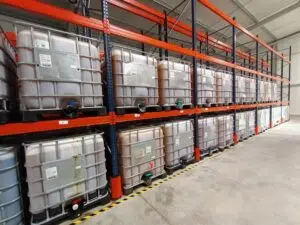
Urine collection by Toopi Organics teams
Toopi Organics, a start-up founded in 2019 has developed – and patented – a solution for converting urine into biostimulants for agriculture and industry. This is possible because human urine is rich in nitrogen, phosphorus, potassium and micronutrients. These are elements that fertilise the soil and provide an excellent growing medium for micro-organisms. However, urine needs to be processed before it can be used by farmers.
That’s why the first plant to collect urine was set up this year in Loupiac-de-la-Réole, close to the company’s premises in Gironde. The transformation is carried out by injecting micro-organisms into the urine, which serves as a growth medium to create biostimulants. After fermentation, an end product can be collected. A product that solubilises phosphorus retained in the soil and stimulates plant and root growth. This plant is the first stone laid in the Toopi building, which wants to see more of these plants located as close as possible to collection points, thereby promoting short distribution channels.
For example, it’s envisaged for a plant to be located near Paris, which would speed up the processing of the urine collected by Happee Services. Once processed, the urine can be spread over entire hectares of crop fields, replacing certain chemical fertilisers that are harmful to the environment. It also gives urine a second life, enabling it to become a useful resource for humans.

